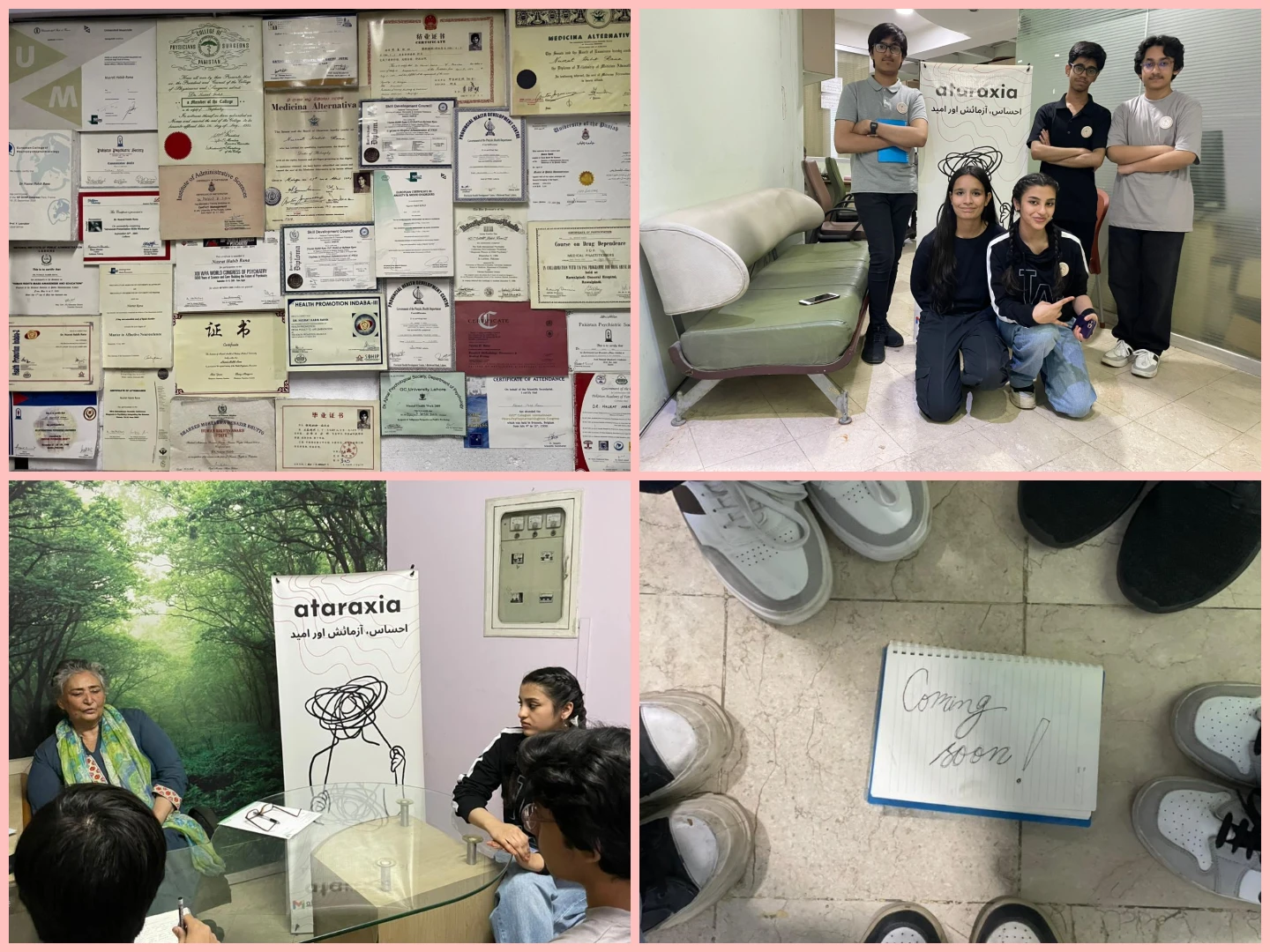
Visit to Jaagrati Psych retreat.
We visited Jaagrati psych retreat, a place located at Eden Heights, Jail road, Gulberg Lahore. Moreover we interviewed Dr. Nusrat Habib Rana who has over 49 years of experience in the field of psycholgoy and has a MD from China, MCPS from Pakistan, Phd from Spain and MSc. Affective Neurosciences from Italy.
Visit to University of Centeral Punjab.
Our team visited the University of Centeral Punjab in Lahore. We conducted a plethora of interviews with experts in the field of psychology. Moreover we gathered immensely valuable data in regards to the effects social media has on the mental health of young people particularly from interviewees who are experts in the field of adolescent psychology.

Our additional interviews:
All our remaining interviews are available on YouTube:
Interview with Nurulain
Nurulain is an associate lecturer at the university of centeral Punjab's department of psychology, She possesses 2 years of experience. She specializes in clinical and counseling psychology in adults and adolescents.
Interview with Imran Mahmood
Imran Mahmood is a lecturer in the psychology department of UCP. He is working on his PhD and possesses a masters in psychology, moreover he has been teaching for over 5 years. Overall he is an extremely well-versed individual in the realm of psychology.
Blog
Social Media: Friend or Foe?
Introduction
Social media has changed the way we do everything. Platforms like Instagram, TikTok, and YouTube offer immense access to information and connection. However, while these platforms have benefits, excessive or unhealthy use can create a variety of mental and emotional problems. To stay healthy we must use this tool wisely.
1. Addiction and Excessive Screen Time
Social media addiction is a major problem that people experience in their daily life. People continue to view platform content because the platforms use methods such as notifications, infinite scrolling and short-form videos. This causes hours of scrolling which makes people become trapped. It reduces a students' ability to concentrate on their studies, which results in academic issues. People who watch screens for excessive periods lose their ability to stay focused on tasks and work effectively.
2. Anxiety, Depression, and Low Self-Esteem
Moreover the excessive use of social media platforms causes people to experience a variety of negative effects. Firstly, Social media pushes a curated image of life, which is usually far from reality. This makes people get trapped in a state of comparison in which they may feel that they are inadequate. This is most prevalent in adolescents and teenagers who are at a critical stage in their growth. On the other hand, young people may check their phones constantly for messages or posts, this constant cycle can result in a feeling of anxiety. The constant exposure may lead to young people having low-self esteem and self-worth which can be part of or cause mental illnesses such as anxiety or depression.
3. Exposure to Unsafe and Toxic Content
Another major issue that social media causes is that of being exposed to unsafe and toxic content. By being surrounded by such negativity online young people can be affected greatly as at that point in one’s life they are forming their identity and world view. The toxic content such as harassment, arguments and other such content influence their very thought process and may result in young people developing such traits.
4. Information Overload
Another major issue of social media is the new trend of bombarding users with information and content. On apps with short-form content people are stuck scrolling watching wildly different things. The amount of content and variability of it can easily overwhelm users, moreover they are unable to close it as it keeps them hooked. The information overload can also result in lowered attention spans and adhd-esque behavioral patterns.
5. Sleep Disruption and Health Issues
Scrolling late at night is a major problem many face. The blue light screens emit is shown to result in sleeping issues and in extreme cases insomnia. Moreover, scrolling at a time when your brain is expecting rest results in mood problems such as irritability from not getting 6-8 hours of sleep. If continued for prolonged periods it can also result in stress related health issues such as an elevated blood pressure.
6. Reduced Real Life Interaction
Spending too much time on social media can also reduce a person's face to face interactions and socialization. Though social media lets one socialize digitally it lacks the benefits of in person interactions. Subsequently young people are disillusioned with the feeling of socializing online even though it lacks the benefits. Humans are social creatures which require socialization to stay mentally well. By reducing socialization one may start to withdraw from living in a healthy manner which may result in mental illnesses.
Conclusion
Social media possesses immense power by offering access to immense stores of information and allowing people all across the world to connect. However excessive and uncontrolled usage may cause a plethora of issues both physical and mental such as elevated blood pressure levels or illnesses such as Anxiety or depression. If one wishes to use social media in a safe and productive way it is important to set boundaries with it, limit usage, and choose in-person activities rather than social media ones. Moreover it is important to take care of yourself by practising mindfulness or other such mental health related activities